
Anyone can send outreach emails — but most get ignored, marked as spam, or politely declined. The difference between a campaign that earns links and one that gets deleted comes down to a handful of habits. These best practices for blogger outreach are exactly those habits: the proven, relationship-first moves that get replies and placements in 2026, distilled into 10 clear rules.
QUICK SUMMARY
- Personalize every pitch — reference the blogger’s actual content, never a copy-paste template.
- Lead with value before you ask for anything — outreach is a trade, not a favor.
- Target relevance over vanity metrics — a relevant mid-size blog beats a huge unrelated one.
- Follow up once, politely — most replies come on the second, respectful email.
- Stay ethical — earn links with great content; buying links and PBNs get you penalized.
The best outreach doesn’t feel like outreach — it feels like a helpful message from someone who actually read your blog.
- What Are the Best Practices for Blogger Outreach?
- The 10 Blogger Outreach Best Practices for 2026
- How to Find the Right Bloggers to Reach Out To
- A Winning Blogger Outreach Email Structure
- Do This, Not That
- Best Practices for Blogger Outreach: Beginner vs Experienced
- How Long Do These Best Practices Take to Pay Off?
- A Quick Real-World Outreach Example
- Learn More: Effective Blogger Outreach in 2026
- Conclusion
- Frequently Asked Questions
- Related Reading
What Are the Best Practices for Blogger Outreach?
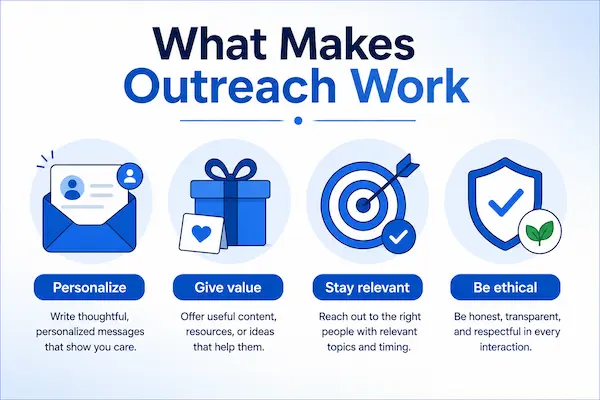
Short answer: Blogger outreach best practices are the proven habits that make outreach campaigns actually work — researching each blogger, personalizing every message, leading with genuine value, following up respectfully, and staying ethical. Together they turn cold, ignored emails into real relationships that earn high-quality backlinks and lasting brand mentions.
None of these are tricks. They’re simply what happens when you treat bloggers like people whose time matters — which, in a world of automated spam, is exactly what makes you stand out.
The 10 Blogger Outreach Best Practices for 2026
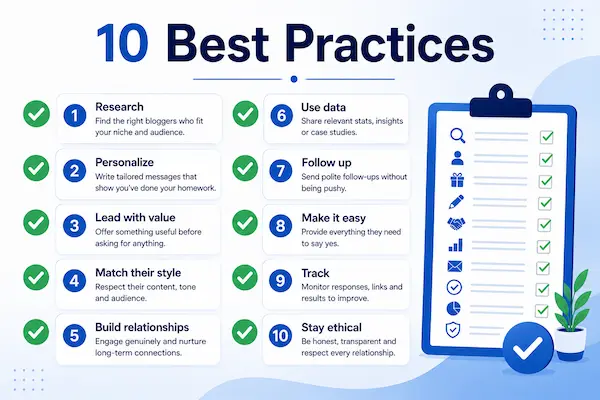
Follow these ten in order and your reply rate — and your links — climb steadily.
1. Research the blogger before you reach out
Read a few recent posts, note their style, and check how they prefer to collaborate. A pitch that shows you actually know their blog instantly stands out.
2. Personalize every message
Reference a specific article and why it resonated. Even one genuine, tailored line beats a whole polished template that screams “mass mail.”
3. Lead with value
Open with what’s in it for them — original content, a useful resource, exclusive data, or exposure to your audience. Give first, ask second.
4. Pitch content that matches their style
Propose topics that fit their audience and fill a real gap on their blog. The easier it is to say “yes,” the more often they will.
5. Build long-term relationships
Share their work, comment thoughtfully, and stay in touch beyond a single ask. Repeat relationships bring repeat links.
6. Back your pitch with data and proof
Statistics, case studies, and examples make your pitch credible and your content more attractive to publish.
7. Follow up — without being pushy
Wait 3–5 days, keep it short and polite, and stop after two attempts. One good follow-up is professional; five is spam.
8. Make collaboration effortless
Provide an outline, a short bio, and a sample so the blogger barely has to work. Less friction means faster yeses.
9. Track your outreach
Log contacts, reply rates, and earned links in a sheet or tool. What you measure, you can improve.
10. Stay ethical and transparent
Avoid buying links, spamming, and low-quality sites. Genuine partnerships are what keep your backlinks (and reputation) safe long-term — a principle Ahrefs and every serious SEO stands behind.
How to Find the Right Bloggers to Reach Out To
Best practices only work if you’re pitching the right people. Build your list from a few free sources before you start:
- Google search operators — try “your topic” + “write for us” or “your topic” + “guest post” to surface blogs that welcome contributors.
- Competitor backlinks — see which blogs already link to your competitors; those sites are warm prospects for you too.
- Blogs you already read — the ones you genuinely enjoy are the easiest to build a real relationship with.
Then vet each one: relevant niche, real recent posts, and genuine reader engagement. Quality of fit beats quantity of contacts every time.
A Winning Blogger Outreach Email Structure
Most guides tell you to personalize but never show you how. Here’s a simple, proven structure you can adapt:
1. Personal opener — one genuine line about a specific recent post.
2. Who you are — one short line of relevant credibility.
3. The value — a concrete idea that helps their readers (topic, data, resource).
4. The easy ask — “Would that be a fit? Happy to send an outline.”
5. Polite sign-off — thank them for their time, no pressure.
Keep it under 120 words. Short, specific, and reader-first wins.
Do This, Not That
The quickest way to remember the rules — a side-by-side of what works versus what quietly kills campaigns:
| ✅ Do this (best practice) | ⚠️ Not that (mistake) |
|---|---|
| Personalize each pitch | Blast identical templates |
| Lead with value first | Ask before giving anything |
| Target relevant blogs | Chase high DA regardless of niche |
| Follow up once, politely | Send five pushy follow-ups |
| Earn links with content | Buy links or use PBNs |
⚠️ Buying links is the fastest way to lose them
It’s tempting to skip the relationship work and just pay for placements, but Google’s spam policies treat paid, manipulative links as violations. Links earned through genuine outreach are the ones that last — and keep your site safe from penalties.
💡 Pro tip: warm up before you pitch
A week before your ask, engage with the blogger — share a post, leave a real comment, reply to their newsletter. When your pitch finally lands, you’re a familiar name, not a cold stranger. This single habit reliably doubles reply rates.
From my own experience
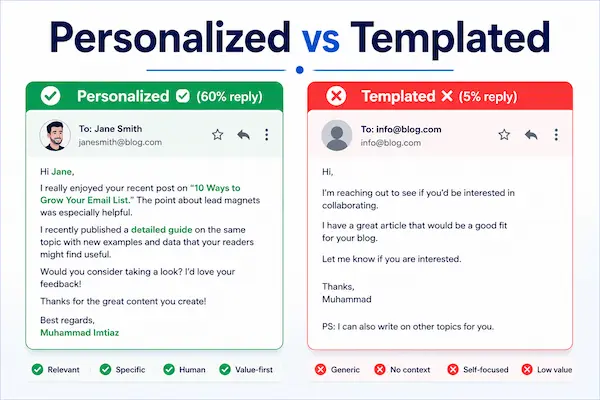
The best practice that changed everything for me was “give before you ask.” On one campaign I spent two weeks genuinely promoting 15 bloggers’ content — sharing, commenting, quoting them — before sending a single pitch.
When I finally reached out, 9 of those 15 said yes. That’s a 60% success rate versus the 5–10% I used to get from cold pitching. Same list, completely different result — because I’d earned the relationship first.
Best Practices for Blogger Outreach: Beginner vs Experienced
The best practices for blogger outreach don’t change as you grow — but where you spend your energy does. Knowing which stage you’re at keeps your effort focused:
| Stage | Where to focus |
|---|---|
| Beginner | One niche, heavy personalization, smaller relevant blogs, a simple tracking sheet. |
| Growing | Add a tool or two, run steady campaigns, and build repeat relationships. |
| Experienced | Systemize with tools, run multiple campaigns, and negotiate ongoing collaborations. |
Whichever stage you’re at, personalization and genuine value stay non-negotiable — they’re the foundation every other tactic is built on.
How Long Do These Best Practices Take to Pay Off?
Blogger outreach is a compounding strategy, not an instant one. Here’s a realistic timeline so you don’t quit too early:
- Days 1–7: first replies start coming in as your personalized pitches land.
- Weeks 2–4: your first placements go live — real links and mentions.
- Months 2–6: those links mature and ranking improvements start showing in Google Search Console.
The teams that win are simply the ones who keep going consistently while others give up after a week of silence.
A Quick Real-World Outreach Example
Here’s how the best practices for blogger outreach look in action. Say you run a small fitness site. You find a mid-size nutrition blog that’s clearly relevant and active. Instead of pitching immediately, you spend a week sharing two of their posts and leaving a genuine comment.
Then you email one specific idea: an original article on “post-workout meals backed by recent studies,” with a couple of data points they don’t already cover. Because you led with value and made it easy to say yes, they accept — and you earn a relevant, editorial backlink plus steady referral traffic. That’s the whole method: relevance, relationship, value, and a clear ask.
Learn More: Effective Blogger Outreach in 2026
This walkthrough from James Taylor SEO covers how to run effective blogger outreach today — a great visual companion that reinforces the best practices above with real examples.
Video: “Guide To Effective Blogger Outreach In 2026” by James Taylor SEO — best practices in action.
Conclusion
Strong best practices for blogger outreach all point in one direction: treat bloggers as partners, not targets. Research them, personalize your message, give value first, follow up with respect, and keep everything honest — and the links, mentions, and relationships follow naturally.
Pick two or three of these habits to fix this week, track your reply rate, and build from there. Consistency beats volume every time, and these ten rules are how outreach becomes a dependable, long-term growth engine.
Want these best practices done for you?
SEOStreamline runs manual, relationship-driven blogger outreach on real, relevant blogs — personalized, ethical, and built to last.
Frequently Asked Questions
What are the most important blogger outreach best practices?
Personalization, leading with value, targeting relevant blogs, respectful follow-ups, and staying ethical. These five underpin almost every successful campaign.
How do I personalize outreach at scale?
Use tools to find contacts and manage sending, but write a genuine, specific opening line for each blog. Automate the admin, never the personalization.
How many times should I follow up?
Once — occasionally twice — spaced 3–5 days apart. Beyond that, you risk being marked as spam and hurting your sender reputation.
Is buying blogger outreach links safe?
No. Paid, manipulative links violate Google’s guidelines and can trigger penalties. Earn links through genuine relationships and quality content instead.
How do I measure if my outreach is working?
Track reply rate, placement rate, new referring domains, referral traffic, and ranking movement in Google Search Console every few weeks.
How long until blogger outreach shows results?
Relationships and links build over weeks to months. Outreach is a compounding, long-term strategy — not an overnight traffic switch.
Related Reading
- What Is Blogger Outreach — the fundamentals, explained simply.
- Blogger Outreach Tools — the 12 best tools to run these practices faster.
- Importance of Blogger Outreach — why it’s worth the effort.
- What Is Guest Posting — the key tactic inside outreach.