
If you’ve already learned about on-page SEO and technical SEO, the next step is understanding what happens outside your website.
That’s where off-page SEO comes in.
Many beginners think SEO is only about optimizing content and fixing technical issues. But in reality, Google also measures how the rest of the internet sees your website.
What is Off page SEO in simple terms:
Off-page SEO is the process of improving your website’s authority and reputation through external signals.
These signals tell Google whether your website deserves to rank higher than competitors. In this blog, you will learn what is off page seo by exploring the following points:
- Why Off-Page SEO Matters More Than You Think
- What Is Off Page SEO and How Does It Work?
- 9 Powerful Off-Page SEO Techniques That Actually Work
- 1. High-Quality Guest Posting
- 2. Niche Edits (Contextual Links)
- 3. Digital PR
- 4. Local Citations (For Local SEO)
- 5. Brand Mentions
- 6. Content Marketing for Link Attraction
- 7. Broken Link Building
- 8. HARO & Journalist Requests
- 9. Social Signals & Content Distribution
- What Off-Page SEO Is NOT
- Off-Page SEO vs On Page SEO
- How Long Does Off-Page SEO Take?
- Final Thoughts
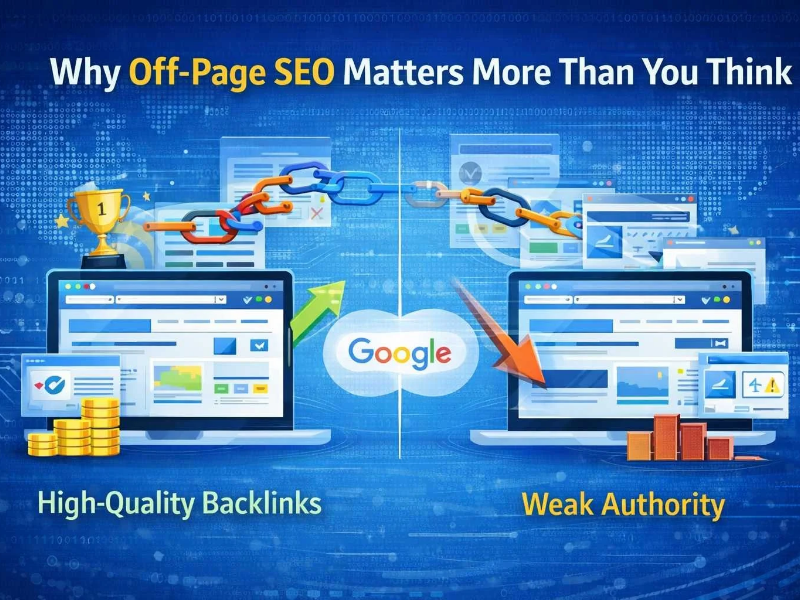
Why Off-Page SEO Matters More Than You Think
You can have:
- Perfect content
- Fast website speed
- Clean technical structure
But if no one links to your website, Google may not trust it enough to rank.
From practical experience, websites with fewer but high-quality backlinks often outrank websites with more content but weak authority.
Google’s algorithm looks at:
- Who links to you
- How relevant those websites are
- How natural your link profile looks
- Brand mentions and trust signals
This is why off-page SEO directly impacts rankings.
You can also read our guide on what is on-page SEO
What Is Off Page SEO and How Does It Work?
Think of backlinks like votes.
If trusted websites in your niche link to your content, Google interprets that as:
“This website is valuable and trustworthy.”
But not all votes are equal.
A backlink from:
- A niche-relevant blog
- A high-authority publication
- A real business website
Is much stronger than:
- Random directories
- Spammy blog comments
- Low-quality link farms
Off-page SEO is about earning the right kind of signals — not just building links blindly.
For more knowledge, you can read a quality blog on what is off page seo
9 Powerful Off-Page SEO Techniques That Actually Work
Here are proven methods that work in today’s SEO environment.
1. High-Quality Guest Posting
Writing valuable content for niche-related websites is still one of the safest link-building methods.
Focus on:
- Relevant websites
- Real traffic
- Editorial standards
Avoid sites that openly sell links.
2. Niche Edits (Contextual Links)
Instead of creating new articles, you can get your link inserted into already-ranking content.
This works well when:
- The content is relevant
- The page already has traffic
- The link adds value
3. Digital PR
Getting mentioned in:
- News sites
- Industry blogs
- Resource pages
Builds authority faster than random backlinks.
Even one strong PR backlink can move rankings significantly.
4. Local Citations (For Local SEO)
If you run a local business, listings on:
- Google Business Profile
- Yelp
- Bing Places
- Industry directories
Help strengthen trust signals.
Consistency of NAP (Name, Address, Phone) is critical.
5. Brand Mentions
Google increasingly recognizes unlinked brand mentions.
If people talk about your business online, even without linking, it builds credibility.
6. Content Marketing for Link Attraction
Publishing:
- Original research
- Case studies
- Data-driven content
- Detailed guides
Naturally attracts backlinks over time.
This is slower but more sustainable.
7. Broken Link Building
Find broken links on other websites and suggest your content as a replacement.
It works because you’re helping the website owner fix a problem.
8. HARO & Journalist Requests
Platforms where journalists request expert quotes can earn you:
- Authority links
- Media mentions
- Brand trust
This method supports strong E-E-A-T signals.
9. Social Signals & Content Distribution
While social media links don’t directly pass authority, they:
- Increase visibility
- Bring traffic
- Improve content reach
More visibility = higher chance of earning backlinks.
What Off-Page SEO Is NOT
Many beginners make these mistakes:
❌ Buying bulk backlinks
❌ Using automated link software
❌ Spamming blog comments
❌ Submitting to thousands of directories
❌ Ignoring link relevance
Google is smarter now. Low-quality links can hurt rankings.
Off-Page SEO vs On Page SEO
- On Page SEO = Optimize your website
- Technical SEO = Fix backend structure
- Off-Page SEO = Build authority outside your website
All three must work together.
If one is weak, rankings suffer.
How Long Does Off-Page SEO Take?
Off-page SEO is not instant.
You may see movement in:
- 4–8 weeks (light competition)
- 3–6 months (moderate competition)
Authority builds gradually.
Consistency beats shortcuts.
Final Thoughts
Understanding what is off page SEO is essential if you want long-term rankings.
It’s not about collecting as many links as possible.
It’s about building:
- Trust
- Authority
- Relevance
- Brand reputation
When your website earns genuine references from other trusted websites, Google rewards that trust.
If you’ve completed On-Page SEO and Technical SEO, off-page SEO is the final pillar that strengthens your overall strategy.