
Every website owner eventually hits the same wall: your content is solid, your on-page SEO is clean, but your rankings just won’t climb. Nine times out of ten, the missing ingredient is authority — and the fastest white-hat way to earn it is by getting your content published on other trusted sites.
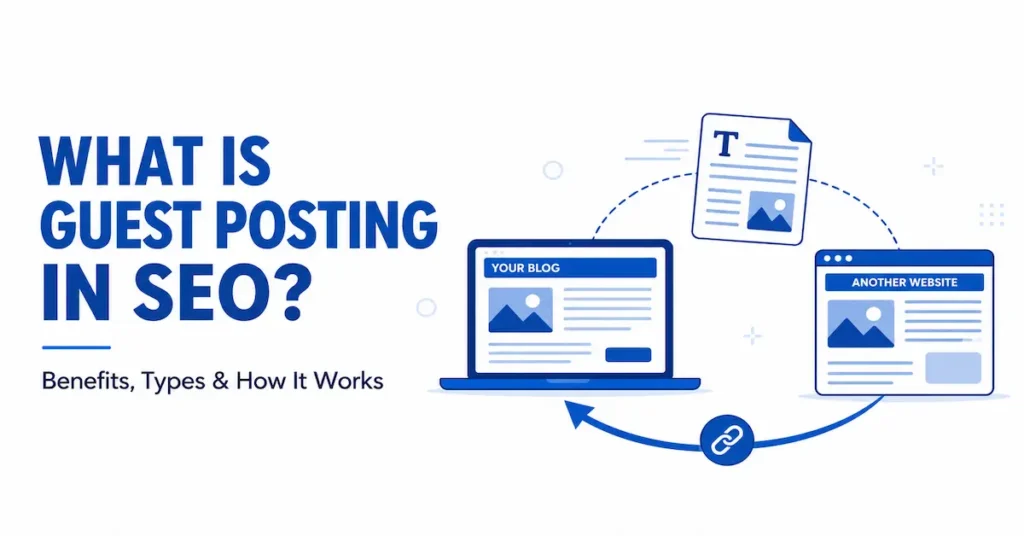
So, what is guest posting in SEO, and why does nearly every serious website rely on it? In simple terms, it’s the practice of writing an article for another website in your niche and earning a backlink to your own site in return.
Done right, it builds authority, referral traffic, and trust all at once. This guide breaks down exactly how it works, its real benefits, the mistakes to avoid, and how to do it safely in 2026.
QUICK SUMMARY
- Guest posting = publishing an article on another website in your niche in exchange for a backlink to yours.
- Why it matters: quality backlinks are still one of Google’s strongest ranking signals — and guest posts earn them the white-hat way.
- Beyond links: it also drives referral traffic, brand awareness, and relationships with other site owners.
- Safety depends on relevance: relevant sites + natural anchors + real content = safe; spammy mass links = risky.
- It’s a skill you can monetize: the same process powers a full guest blogging outreach business.
Guest posting isn’t about begging for links — it’s about trading genuine value (great content) for genuine authority (a relevant backlink). That trade is what moves rankings.
- What Is Guest Posting in SEO?
- Why Guest Posting Matters for SEO
- How Guest Posting Works (Step by Step)
- 7 Key Benefits of Guest Posting
- Types of Guest Posting Links (and Which Are Safe)
- Common Guest Posting Mistakes to Avoid
- Learn More: Watch a Real Guest Posting Case Study
- Conclusion
- Frequently Asked Questions
- Related Reading
What Is Guest Posting in SEO?
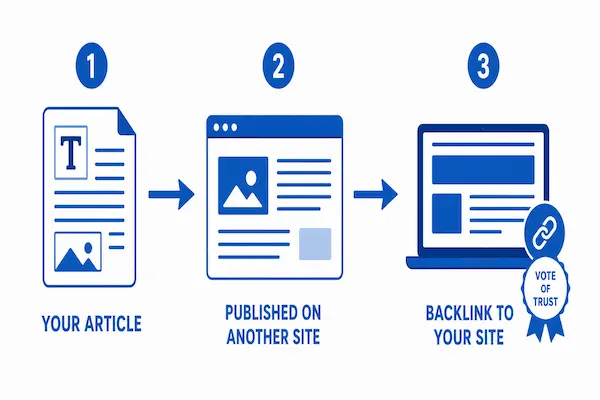
Short answer: Guest posting in SEO is the practice of writing and publishing an article on someone else’s website — one relevant to your niche — in exchange for a backlink pointing to your own site. Search engines treat that backlink as a “vote of confidence,” so relevant, high-quality guest posts help build your site’s authority, improve rankings, and drive referral traffic.
Think of a backlink as a recommendation. When a respected website in your industry publishes your article and links back to you, it’s effectively telling Google, “this source is worth trusting.” The more relevant and authoritative those recommendations are, the more search engines trust your site. Guest posting is simply the most reliable, editorial way to earn those recommendations — because you’re providing real content the host site actually wants to publish.
Why Guest Posting Matters for SEO
Google’s algorithm still leans heavily on backlinks to judge how trustworthy and authoritative a website is. But not all links are equal — a link from a relevant, reputable site carries far more weight than a random directory or comment link.
Guest posting sits at the sweet spot: the links are editorial (a real person chose to publish your content), contextual (placed inside relevant content), and relevant (on a site in your niche). That combination is exactly what Google wants to reward, which is why guest posting remains a cornerstone of off-page SEO rather than a shortcut.
How Guest Posting Works (Step by Step)
The process is straightforward once you see the full sequence. Every successful guest post follows roughly these four steps:
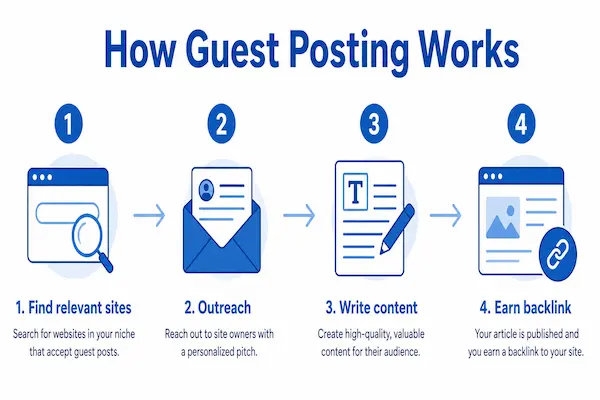
1. Find relevant websites
Identify sites in your niche that accept guest posts, have real traffic, and maintain decent authority. Quality and relevance matter far more than quantity.
2. Reach out to site owners
Send a personalized pitch — not a copy-paste template — proposing a topic that fits their audience and fills a genuine content gap.
3. Create valuable content
Write an original, genuinely useful article that meets the host site’s standards. The better the content, the more likely it’s accepted and the longer it stays live.
4. Earn a contextual backlink
Once published, your article includes a natural, in-context link back to your site — passing authority and sending interested readers your way.
7 Key Benefits of Guest Posting
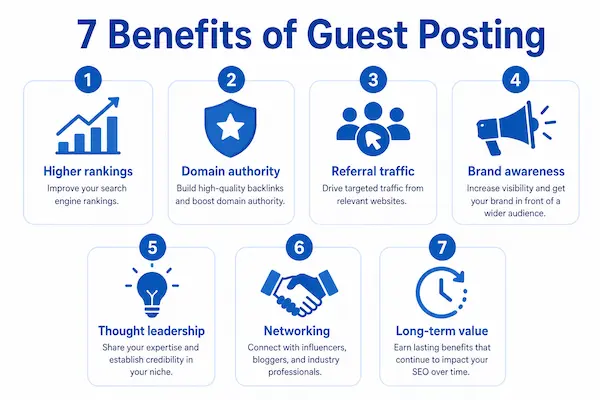
Guest posting pays off on several fronts at once — which is why it’s worth the effort:
- Higher search rankings from quality, relevant backlinks.
- Stronger domain authority as trusted sites vouch for you.
- Direct referral traffic from readers who click through.
- Brand awareness in front of a new, relevant audience.
- Thought-leadership positioning as an expert in your field.
- Relationships and networking with other site owners and editors.
- Long-term compounding value — a good backlink keeps working for years.
Independent research backs this up: guest blogging is consistently ranked among the most popular link-building tactics by SEOs, as Ahrefs documents in its own analysis of the strategy.
Types of Guest Posting Links (and Which Are Safe)
Not every guest post link is created equal. Understanding the difference is what keeps your backlink profile healthy — and separates white-hat guest posting from the spammy kind Google penalizes.
| Factor | ✅ White-Hat Guest Posting | ⚠️ Spammy Guest Posting |
|---|---|---|
| Site relevance | Closely related to your niche | Any site that will publish, unrelated |
| Anchor text | Natural, varied, branded | Exact-match keywords, over-optimized |
| Content quality | Original, genuinely useful | Thin, spun, or AI-dumped filler |
| Volume | Selective, steady | Mass-bought in bulk |
| Likely outcome | Ranking and authority gains | Devalued links or a penalty |
⚠️ Don’t cross the line into link spam
Google’s spam policies specifically flag “links with optimized anchor text in articles, guest posts, or press releases distributed on other sites.” Translation: guest posting is completely fine — but stuffing exact-match anchors onto irrelevant sites is not. Keep it relevant, natural, and content-first, and your links stay safe.
💡 Pro tip: pitch the topic, not yourself
The fastest way to get a guest post accepted is to make the editor’s job easy. Instead of asking “can I write for you?”, pitch 2–3 specific, ready-to-write titles that fill a visible gap on their blog. A relevant, concrete idea gets a “yes” far more often than a generic request — and it instantly signals you actually read their site.
From my own experience (replace with your exact figures)
On one of my client sites, a single well-placed guest post taught me how much relevance matters. In early 2025 I landed a post on a niche marketing blog with a Domain Rating of about 45 — genuinely relevant, real traffic. Within roughly six weeks, the target page climbed from position 14 to position 6 for its main keyword, and I could see 30–40 referral visits a month coming directly from that one article. Compare that to three “cheap” links I’d bought earlier on unrelated sites, which did absolutely nothing. That contrast is the whole lesson: one relevant guest post beat ten irrelevant ones — quality and relevance win every time.
Common Guest Posting Mistakes to Avoid
Chasing low-quality, irrelevant sites
A link from an unrelated, spammy site adds no value and can even hurt you. Relevance and authority come before quantity, always.
Over-optimizing anchor text
Using the same exact-match keyword as your anchor on every post is a classic spam signal. Keep anchors natural, varied, and often branded.
Sending templated outreach
Generic “Dear webmaster” emails get ignored. Personalized pitches that reference the site’s actual content get replies.
Publishing thin or spun content
Low-effort articles get rejected, removed, or simply never read. Treat every guest post like a piece for your own site.
Buying guest posts in bulk
Mass-purchasing links on a network of low-quality sites is exactly what Google’s link-spam systems target. Slow, selective, and relevant beats fast and cheap.
Ignoring traffic and audience fit
A high metric score means little if the site has no real audience. Check for genuine traffic and engaged readers before you pitch.
Learn More: Watch a Real Guest Posting Case Study
The video below from SEO creator Darrel Wilson walks through what guest posting is and how he used it to grow reach and domain authority quickly. It’s a practical, results-focused explainer that complements everything covered above — a useful watch if you want to see the strategy applied to real numbers.
Video: “What Is Guest Posting and How I Used It To Increase Our Reach by 1100% and +7 DA in 30 days” by Darrel Wilson — a real-world case study of the strategy in action.
Conclusion
Now that you know what is guest posting in SEO — publishing valuable content on relevant sites to earn editorial backlinks — the key takeaway is simple: it works because it’s built on genuine value, not tricks. Focus on relevant sites, natural anchors, and content you’d be proud to publish on your own blog, and guest posting will steadily grow your authority, rankings, and traffic. Avoid the spam shortcuts, stay consistent, and treat every placement as a relationship rather than a transaction. Do that, and each guest post becomes a long-term asset working quietly in your favor.
Want to turn guest posting into income?
The same skills that build your own backlinks can become a full service business. See how in our complete guide to building a guest blogging outreach business.
Frequently Asked Questions
Is guest posting good for SEO?
Yes. It’s one of the most effective white-hat ways to earn relevant, editorial backlinks — which remain a strong ranking signal — while also driving referral traffic and brand awareness.
How do guest posts work?
You write an article for another website in your niche, and in return your content includes a backlink to your own site. The host gets free quality content; you get authority and traffic.
Are guest post backlinks safe?
They’re safe when placed naturally on relevant, high-quality sites with varied anchors. They become risky only when mass-bought on irrelevant sites with over-optimized anchor text.
How do I find guest posting sites?
Through Google search operators, SEO tools like Ahrefs, outreach to niche blogs, and networking. Prioritize relevance and real traffic over raw metrics.
Can guest posting improve rankings?
Yes — high-quality, relevant guest post backlinks build authority over time, which can lift rankings, referral traffic, and overall trust in your domain.
What is guest posting in SEO used for?
It’s used to build backlinks, increase domain authority, improve search rankings, and drive targeted referral traffic — all through relevant, editorial placements.
How many guest posts should I do each month?
There’s no fixed number — a few genuinely relevant, high-quality placements beat dozens of low-quality ones. Consistency and relevance matter more than volume.
Related Reading
- Guest Blogging Outreach Business: The Complete GBOB Guide — turn this skill into a business.
- How to Get Backlinks for SEO — the wider link-building picture.
- Types of Backlinks in SEO — understand dofollow, nofollow, and contextual links.
- What Is Blogger Outreach — the outreach side of earning placements.
- Domain Rating vs. Domain Authority — how to judge a site’s strength before you pitch.