
“This site has a DA of 62.” “We only accept guest posts from DA 40+ sites.” You’ll hear sentences like these constantly in SEO and outreach conversations but most people using the term couldn’t tell you exactly what it measures, who created it, or why it doesn’t mean what most beginners assume it means.
This guide covers the domain authority definition in full: what it actually measures, who built it, how it’s calculated, whether Google uses it, how it compares to similar metrics, and exactly how to improve it — with realistic examples throughout, not just theory.
⚡ 6 Key Things to Know About Domain Authority
- It’s a 1–100 prediction score, not a quality score. Moz created it to estimate ranking potential, not to grade how “good” a site is.
- Google does not use it. It’s a third-party SEO industry benchmarking tool — Google’s algorithm never references it.
- It’s calculated mainly from backlinks. Referring domain diversity, backlink quality, and spam signals feed a machine-learning model.
- Competing metrics measure it differently. Ahrefs’ Domain Rating and Semrush’s Authority Score are similar in concept but never numerically comparable.
- A lower score can still outrank a higher one. Content quality and search intent match matter more than the raw DA number.
- It improves gradually, never overnight. Consistent, genuine link-building is the only reliable way to raise it — there’s no single shortcut.
The domain authority definition, in one line: a 1–100 score developed by Moz to predict how likely a website is to rank in search results, based primarily on the size and quality of its backlink profile.
- Domain Authority Definition: What It Actually Means
- A Simple Example: Two Bookstores
- Why Understanding This Matters for Your SEO
- Does Google Use Domain Authority?
- Who Created Domain Authority, and Are There Alternatives?
- How Is Domain Authority Calculated?
- Learn More
- What Is a Good Domain Authority Score?
- Can a Low Domain Authority Website Rank Higher?
- Domain Authority vs. Page Authority: A Common Mix-Up
- How to Check Your Website's Domain Authority
- How to Improve Domain Authority
- What Realistic Domain Authority Growth Looks Like for New Sites
- Common Myths About Domain Authority
- Conclusion
- Frequently Asked Questions
Domain Authority Definition: What It Actually Means
Short answer: The domain authority definition is a Moz metric, scored 1–100, that estimates a website’s ranking potential relative to other sites — based mainly on backlink quality and quantity, not content or traffic.
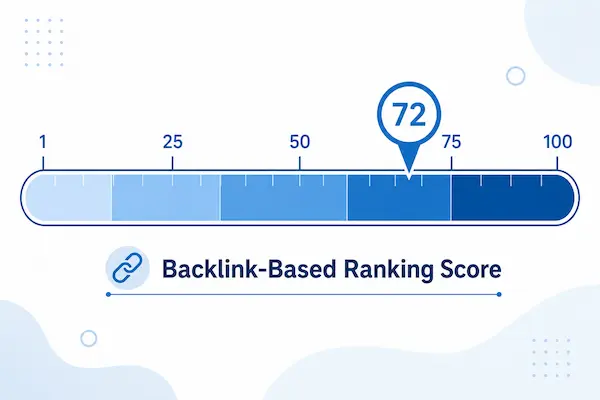
The score ranges from 1 to 100. Generally, the higher the score, the stronger the website’s overall authority based primarily on its backlink profile. Importantly, Domain Authority is not a Google ranking factor — Google has never used Moz’s metric in its algorithm. It’s a third-party tool built to help SEO professionals evaluate and compare websites quickly.
For example: a brand-new website may sit at DA 1–5, a growing small business site around DA 20–30, well-established niche publications DA 40–60, and major global publishers can exceed DA 90. Comparing your site against the entire internet isn’t useful — comparing it against direct competitors in your niche is.
Official reference: Moz’s Domain Authority guide.
A Simple Example: Two Bookstores
Imagine two bookstores opening in the same city. The first has operated for 20 years, gets recommended by hundreds of loyal readers, and is regularly featured in local newspapers. The second opened last week with almost no recommendations yet.
Most people naturally trust the first bookstore more — not purely because of its age, but because of the accumulated trust, references, and reputation it’s earned over time. Domain Authority works the same way: sites earn it through quality backlinks, consistent trust signals, and genuine reputation, not simply by existing longer. And just like a bookstore that suddenly papers the town with low-quality flyers doesn’t instantly earn the same trust as decades of word-of-mouth, a website can’t shortcut its way to the same effect with a burst of low-quality backlinks either.
Why Understanding This Matters for Your SEO
Grasping the domain authority definition helps beginners evaluate site strength before planning link-building, guest posting, or content partnerships. Although Google doesn’t use it directly, it remains one of the most widely referenced SEO metrics in the industry — helping you compare competitors, evaluate backlink opportunities, and benchmark your own progress over time. Agencies and freelance SEOs also use it as a quick shorthand when reporting progress to clients who aren’t familiar with more technical backlink metrics, since a single 1-100 number is far easier to communicate than a full backlink audit.
⚠️ Watch out: Treating DA as a target to chase — rather than a byproduct of good SEO work — is the most common mistake beginners make. Sites that focus purely on the number often end up buying low-quality links, which can hurt search visibility even as the DA score temporarily rises.
Does Google Use Domain Authority?
No. Google has repeatedly and directly confirmed that it does not use Moz’s Domain Authority score as a ranking signal. Instead, Google’s algorithm evaluates hundreds of independent ranking factors — content helpfulness, search intent match, internal linking, page experience, genuine backlink quality, and E-E-A-T signals among them. Google’s own SEO Starter Guide outlines these fundamentals directly, without ever referencing third-party authority scores. Think of Domain Authority as an SEO benchmarking tool for professionals, not something Google’s crawlers reference at all.
Who Created Domain Authority, and Are There Alternatives?
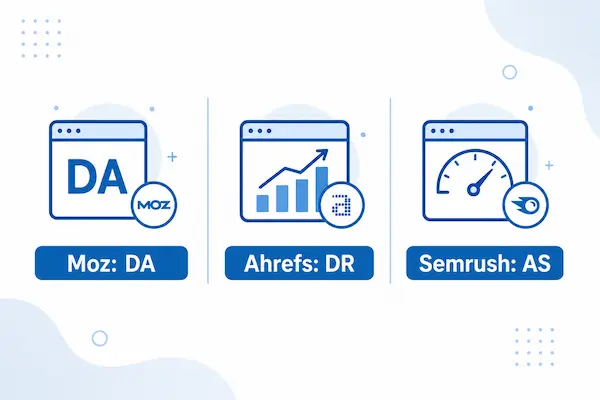
Domain Authority was developed by Moz, one of the earliest and most influential SEO software companies, to help marketers estimate the relative strength of websites at a glance. Over time, competing platforms built their own similar metrics, each using different data and calculations:
| Platform | Metric | Score Range |
|---|---|---|
| Moz | Domain Authority (DA) | 1–100 |
| Ahrefs | Domain Rating (DR) | 0–100 |
| Semrush | Authority Score (AS) | 0–100 |
| Majestic | Trust Flow / Citation Flow | 0–100 each |
None of these tools share a formula, so the same website will almost always show different scores across platforms — each measures a slightly different data set with its own weighting. We’ll cover the DA-vs-DR comparison in more depth in our upcoming guide comparing Domain Rating and Domain Authority directly.
How Is Domain Authority Calculated?
Moz calculates Domain Authority using a machine-learning model that weighs dozens of signals together, rather than any single factor in isolation — total referring domains, backlink quality, the authority of linking sites, link diversity, and spam signals among the most influential. Because the calculation weighs so many factors together, there’s no single action that instantly raises your score; it improves gradually as your site earns genuinely trustworthy backlinks and builds a consistent publishing history.
Ahrefs’ own explainer on its comparable Domain Rating metric notes that scores like this move on a logarithmic scale — the climb from 70 to 71 takes far more accumulated link equity than the climb from 20 to 21, which is a big part of why top-tier sites are so hard to displace and why realistic, incremental progress is the norm, not the exception.
💡 Pro tip: Don’t chase a specific DA target number. Focus on the inputs — quality backlinks, technical health, content depth — and treat the score as a lagging indicator you check quarterly, not weekly.
Learn More
Watch: Domain Authority Explained in Under 2 Minutes
A quick visual walkthrough of the PA/DA fundamentals covered in this guide — the same video referenced on our High Domain Authority Websites cluster post.
What Is a Good Domain Authority Score?
There’s no single universal “good” score — context matters more than the raw number. Compare your score against direct competitors in your specific industry rather than the internet as a whole.
| Domain Authority | Meaning |
|---|---|
| 1–10 | Brand-new website, still building trust |
| 11–20 | Growing website with early traction |
| 21–40 | Average, established business website |
| 41–60 | Strong authority within its niche |
| 61–80 | Highly authoritative, well-recognized site |
| 81–100 | Industry-leading, globally recognized websites |
A website with DA 30 can genuinely outperform one with DA 70 in search rankings if its content better satisfies what the searcher is actually looking for. The score is a helpful benchmark, never a guarantee — see real examples of top-tier sites in our upcoming guide to high domain authority websites.
Can a Low Domain Authority Website Rank Higher?
Absolutely — and this happens more often than beginners expect. A website with DA 15 can outrank a website with DA 60 if it has genuinely better, more comprehensive content, stronger topical authority in that niche, faster page speed, and a closer match to what the searcher actually wants. This is precisely why experienced SEOs focus primarily on creating valuable, well-targeted content rather than chasing authority scores as an end goal.
A common real-world version of this: a small, highly specialized niche blog with DA 22 regularly outranks general-interest sites with DA 50+ for its specific long-tail keywords, simply because its content demonstrates deeper, more direct expertise on that exact topic than a broader site ever will.
Domain Authority vs. Page Authority: A Common Mix-Up
Beginners frequently confuse Domain Authority with Page Authority (PA) — also a Moz metric, also scored 1–100, but measuring something different. Domain Authority predicts the ranking strength of an entire website; Page Authority predicts the ranking strength of one specific page on that site.
A site with a high overall DA can still have individual pages with low PA if those pages are new, thin, or poorly linked internally. Conversely, a single exceptional page — one that’s earned strong external backlinks of its own — can have a higher PA than the site’s average, even on a relatively young domain. When you’re evaluating a guest post opportunity, checking the specific page’s PA (not just the site’s DA) gives you a more accurate picture of how much link equity that particular placement will actually pass.
How to Check Your Website’s Domain Authority
You don’t need a paid subscription to check your own score. Moz offers a free Domain Authority checker and browser extension (MozBar) that shows the current DA and PA of any page you’re viewing, along with basic linking-root-domain data.
A few practical notes when checking scores: give a new site at least a few months before expecting a meaningful score, recheck no more than monthly since the metric updates periodically rather than in real time, and always compare your result against 3-5 direct competitors rather than judging the number in isolation.
How to Improve Domain Authority
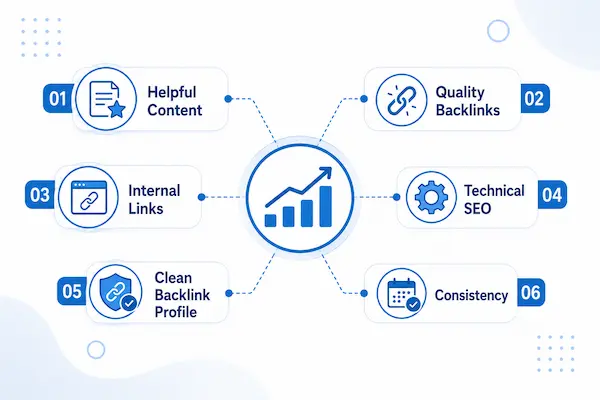
Improving Domain Authority requires consistent, long-term SEO effort — there are no reliable shortcuts. Here are the proven strategies that actually move the needle:
Publish Genuinely Helpful Content
Create comprehensive articles that thoroughly solve your readers’ actual problems, rather than thin content built purely around a keyword. Content that genuinely answers a question tends to attract natural citations and backlinks over time, without any outreach at all.
Earn Quality Backlinks, Don’t Buy Them
Focus on backlinks from relevant, trustworthy websites through genuine outreach rather than purchasing links in bulk. A handful of relevant, editorially-earned links will do more for your score than dozens of paid placements on unrelated directories.
Build a Strong Internal Linking Structure
Help search engines understand your website’s structure and topical depth by connecting related pages logically — exactly what this pillar-and-cluster structure is designed to do. Internal links also help distribute the authority your strongest pages have earned across the rest of your site.
Improve Technical SEO Fundamentals
Ensure your website loads quickly, works well on mobile, and is easy for search engines to crawl and index without errors. A site that’s difficult to crawl can quietly waste the link equity it’s already earned.
Audit and Remove Harmful Backlinks
Regularly review your backlink profile using tools like Google Search Console and disavow genuinely toxic, spammy links when necessary. This matters more for sites that have previously used aggressive or purchased link-building tactics than for sites with a naturally clean history.
Stay Consistent Over Time
Authority compounds gradually. Websites that publish and build links consistently over months and years see far more durable growth than those chasing quick wins. Our upcoming step-by-step guide on how to increase domain authority covers this process in full depth.
What Realistic Domain Authority Growth Looks Like for New Sites
If your site is brand new, expect to start near DA 1, and don’t be discouraged by how slowly the number moves in the first few months — this is normal, not a sign that something’s broken. Most new, actively-promoted sites see their first meaningful jump (into the DA 10-15 range) somewhere between month 3 and month 6, once a handful of genuine referring domains have accumulated.
Growth beyond that tends to slow further as the scale becomes more logarithmic — the jump from DA 5 to DA 15 is far easier than the jump from DA 40 to DA 50. Set expectations around this curve from the start, and measure progress in relevant referring domains earned, not just the headline number.
Common Myths About Domain Authority
Myth 1: Google uses Domain Authority as a ranking factor. Reality: Google has confirmed it does not use Moz’s DA metric.
Myth 2: Buying backlinks quickly increases DA. Reality: Low-quality, purchased backlinks often damage your SEO and can trigger penalties.
Myth 3: DA is the single most important SEO metric. Reality: Content quality and genuine user satisfaction matter far more for actual rankings.
Myth 4: A high DA guarantees top rankings. Reality: Rankings depend on hundreds of signals working together, not one score.
Myth 5: Domain Authority is a fixed, permanent score. Reality: It’s recalculated periodically and is relative to the rest of the web — your score can shift even without any change to your own site.
📊 From practical outreach experience:
One client site sat stuck at DA 18 for over a year despite monthly blogging. After we shifted focus for 5 months to just two things — closing competitor backlink gaps and tightening internal links — DA reached 27, and organic traffic grew alongside it. Nothing about their publishing frequency changed; only the link strategy did.
Conclusion
Understanding the domain authority definition helps you use this metric correctly, rather than chasing it blindly. Domain Authority is a genuinely valuable benchmarking tool developed by Moz to estimate the relative strength of a website. It’s useful for competitor analysis and link-building decisions, but it should never be treated as a direct Google ranking factor or a substitute for content quality. Prioritize helpful content, high-quality backlinks, technical SEO fundamentals, and a strong user experience — those efforts move rankings far more reliably than chasing a higher DA score ever will.
Want a link-building strategy built around genuine authority, not just chasing a number?
Frequently Asked Questions
What is the domain authority definition?
A 1–100 score developed by Moz that predicts how likely a website is to rank in search results compared to others, based mainly on backlink quality and quantity.
Does Google use Domain Authority?
No. Google has confirmed it does not use Moz Domain Authority as a ranking factor.
What is a good Domain Authority score?
It depends entirely on your competitors. For many small businesses, DA 20–40 is a solid, realistic starting point.
How is Domain Authority calculated?
Via machine learning, weighing backlink quality, referring domains, link diversity, and overall link profile strength together.
How can I improve my Domain Authority?
Create valuable content, earn high-quality backlinks, improve technical SEO, strengthen internal linking, and maintain a natural, spam-free backlink profile.
Is Domain Authority the same as Domain Rating?
No. Domain Authority is Moz’s metric; Domain Rating is Ahrefs’. Both estimate authority but use different data and formulas.
Related Reading
More on this topic soon: our upcoming guides on high domain authority websites, how to increase domain authority, Domain Authority vs Authority Score, and Domain Rating vs Domain Authority — each will be linked here as it publishes.