
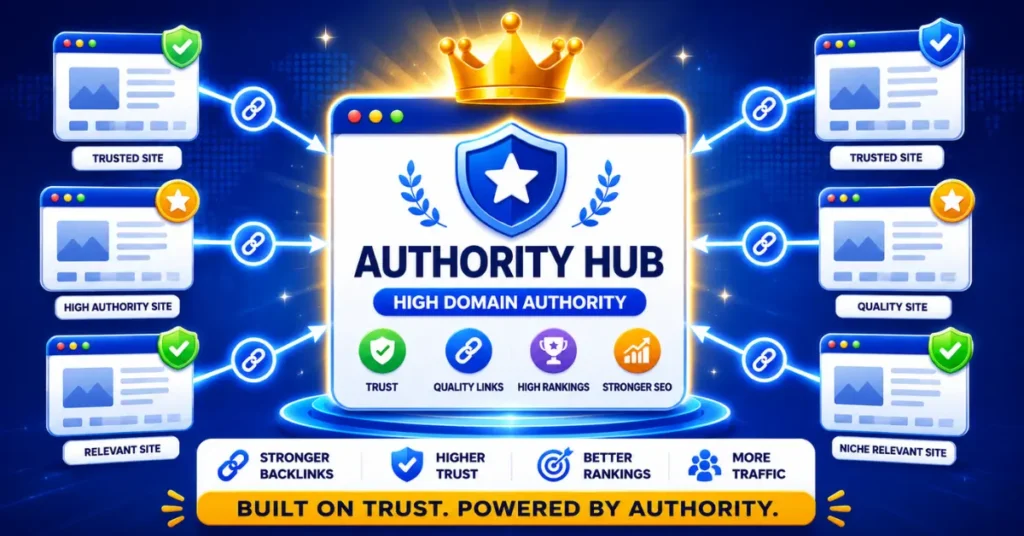
Not every backlink carries the same weight. A single mention on a globally recognized website can move the needle for your SEO more than dozens of links from small, unknown blogs — and that difference usually comes down to Domain Authority.
If you’re building a link-building or guest posting strategy, it helps to know what high domain authority websites actually look like in practice, not just in theory. Seeing real examples makes the concept far easier to apply than reading a definition alone, and it’s a natural next step after our domain authority definition guide.
⚡ TL;DR
- These sites typically sit around DA 70 and above on Moz’s 1–100 scale.
- Seven widely-cited examples include Wikipedia, Forbes, The New York Times, HubSpot, Moz, TechCrunch, and university (.edu) sites.
- They earned it slowly — through years of quality backlinks, consistent publishing, and clean link profiles, not shortcuts.
- Relevance beats raw score — a relevant DA 30 site often outperforms an unrelated DA 90 site as a link source.
- Use this list as a benchmark, not a target list — you’re very unlikely to get a direct link from any of these seven.
These are the sites Moz’s scoring model places near the top of its 1–100 scale — usually DA 70 and above — earned through years of high-quality backlinks and consistent trust signals, not shortcuts.
- What Are High Domain Authority Websites?
- Why This List Matters for Your SEO
- 7 Well-Known High-Authority Sites to Study
- What These High-Authority Sites Have in Common
- High Authority vs. High Traffic: Not the Same Thing
- How to Use This List in Your Own SEO Strategy
- Learn More
- Conclusion
- Frequently Asked Questions
What Are High Domain Authority Websites?
Short answer:
These sites — often called high authority domains in outreach and link-building conversations — score near the top of the 1–100 Domain Authority scale, typically DA 70 and above, based on backlink quality and volume.
For background on how this metric is calculated, see our full domain authority definition guide. These sites have usually earned their position over years, through a large volume of high-quality backlinks, consistent publishing, and strong overall trust signals. They didn’t reach a high score overnight, and neither will your website — but studying them shows you what sustained authority-building actually looks like.

Why This List Matters for Your SEO
You’ll run into sites like these in a few practical situations:
- Evaluating whether a guest posting opportunity is worth pursuing
- Checking who is already linking to your competitors
- Deciding which directories, publications, or partners to prioritize for outreach
- Benchmarking your own site’s authority against realistic, established examples
A link from a genuinely high-authority, relevant site is worth far more than several links from low-authority, unrelated ones — the short version of what our outreach process is built around. Seeing real, named examples also makes it much easier to spot the difference between a site that has genuinely earned its authority and one that’s simply large or well-known without the underlying backlink quality to match.
⚠️ Watch out: A high DA number alone doesn’t guarantee a good link source. Some high-scoring sites carry that score from old, unrelated content and would pass little real value to a niche site — relevance and a clean backlink profile matter just as much as the number.
7 Well-Known High-Authority Sites to Study
Here are seven well-known websites widely cited in the SEO industry as examples of very high Domain Authority. Exact scores shift over time as Moz recalculates its index, so treat these as directional examples of authority tiers rather than fixed numbers.
| Website | Category | Why It’s High-Authority |
|---|---|---|
| Wikipedia.org | Reference | Near-universal linking from other sites |
| Forbes.com | Publisher | Constant citations from businesses and press |
| NYTimes.com | News | Decades of citations and trusted coverage |
| HubSpot.com | SaaS / Marketing | Years of widely-referenced marketing content |
| Moz.com | SEO Education | Extensive, frequently cited SEO resources |
| TechCrunch.com | Tech News | Regular linking from startups and investors |
| University (.edu) sites | Academic | Age, academic citations, research references |
1. Wikipedia.org
Wikipedia is one of the most frequently cited examples of a maximum-authority website. Its enormous page count, constant editing activity, and near-universal linking from other sites make it a benchmark most SEOs use as the top of the scale. Almost every industry, topic, or niche has a Wikipedia page that outranks dedicated specialist sites simply because of this accumulated trust.
2. Forbes.com
As a major global publisher, Forbes earns backlinks from an enormous range of businesses, journalists, and other publications, which keeps its authority consistently high. Its contributor network also means new, individually-authored articles inherit the authority of the wider domain almost immediately.
3. The New York Times (nytimes.com)
Established news publishers like the Times accumulate authority through decades of citations, references, and coverage from other trusted sites — the same trust-compounding effect explained in our domain authority definition guide. Original reporting and data journalism in particular tend to attract citations from other publishers, which reinforces the score over time.
4. HubSpot.com
HubSpot is a strong example of a business site (rather than a media outlet) reaching high authority through years of consistently helpful marketing and SEO content that other sites naturally reference and link to. It’s a useful reminder that high authority isn’t reserved for news publishers — a company blog can get there through sustained content quality.
5. Moz.com
It’s fitting that Moz, the creator of the Domain Authority metric itself, is consistently used as an example of a high-authority SEO resource — largely due to its extensive, frequently cited educational content and its long track record as a go-to reference in the SEO community.
6. TechCrunch.com
As a leading technology news outlet, TechCrunch is regularly linked to by startups, investors, and other publications covering the same stories, which sustains its high authority over time. Being the first outlet to break a funding announcement or product launch tends to generate a fresh wave of backlinks with every story.
7. University (.edu) websites
Many individual university websites — research pages, academic departments, and library resources — carry high authority due to their age, academic citations, and the large number of external sites referencing their research and resources. This is also why .edu backlinks are frequently, and sometimes misleadingly, marketed as especially valuable in link-building pitches.
💡 Pro tip: When you’re evaluating a real prospect (not a household name like the ones above), weigh topical relevance and referring-domain diversity as heavily as the raw DA number — a relevant DA 30 site is often a better link than an unrelated DA 90 one.
What These High-Authority Sites Have in Common
Looking across these examples, a few shared traits stand out:
- Long publishing history and consistent content output
- A large number of unique referring domains, not just total backlinks
- Backlinks from other already-trusted sites, not low-quality directories
- Genuine topical relevance and depth, not thin or repetitive content
- Minimal spam signals across their backlink profile
None of these sites reached high authority through a shortcut — they earned it the same way our domain authority definition guide describes: gradually, through genuine trust and quality signals. Ahrefs’ own explainer on its comparable Domain Rating metric notes that authority scores like this move on a logarithmic scale — meaning the climb from 70 to 71 takes far more link equity than the climb from 20 to 21, which is part of why these top-tier sites are so hard to displace.

High Authority vs. High Traffic: Not the Same Thing
It’s easy to assume a high-DA site automatically gets massive traffic, or that a high-traffic site must have a high DA — neither is guaranteed. Domain Authority is calculated almost entirely from backlink data, while traffic depends on far more: content freshness, search demand for the topic, brand searches, paid promotion, and social distribution.
A well-established SEO blog can carry a very high DA from years of accumulated backlinks while publishing only occasionally, generating modest traffic relative to its score. Meanwhile, a trending news site can pull huge traffic spikes around a single viral story without that traffic translating into a proportionally high DA, since traffic alone doesn’t create backlinks. When you’re evaluating a potential link or partnership, checking both metrics — authority and estimated traffic — gives a far more complete picture than either one alone.
How to Use This List in Your Own SEO Strategy
You’re unlikely to get a backlink directly from Wikipedia or Forbes — and that’s fine. The real value of studying sites like these is learning what to look for at a smaller, more realistic scale:
- Prioritize outreach to sites with strong topical relevance over sites with the highest raw score
- Check whether a potential partner site has a healthy mix of referring domains, not just a high number
- Use high-authority sites as citation sources in your own content, which can improve trust signals
- Study the content structure and depth of high-authority competitors in your niche as a benchmark

📊 From practical outreach experience:
When I’m reviewing a guest posting opportunity, I don’t just check the raw DA number — I open the site’s existing content and look at who else has linked to it recently. I’ve turned down placements on sites with a DA above 50 because their backlink profile was full of unrelated directories and low-quality link networks, and accepted placements on DA 25–30 sites with genuinely relevant, well-linked content instead. The list above is a good reference point, but relevance and a clean backlink profile matter just as much as the number itself.
Learn More
Watch: Understanding Domain Authority and High-Authority Sites
This video covers the DA/PA fundamentals referenced throughout the examples above — also embedded on our pillar guide, since the concepts apply directly here.
Conclusion
High domain authority websites earn their position the slow way — years of quality backlinks, consistent publishing, and clean link profiles, not a single trick. Use the seven examples above as a benchmark for what “high authority” actually looks like, then apply the same relevance-first thinking to the smaller, realistic prospects you’re actually able to reach through outreach. For the full mechanics of the score itself, our domain authority definition guide is the best next read.
Want links from genuinely relevant, high-quality sites instead of guessing at DA numbers alone?
Frequently Asked Questions
What counts as a high domain authority website?
Most SEOs consider DA 70 or above high, though it’s relative — comparing a site against direct competitors in the same niche matters more than this scale alone.
Can I get a backlink from a very high DA website easily?
Generally no. Sites like Wikipedia, Forbes, or The New York Times have strict editorial standards, and links from them are earned through genuine coverage, not typical outreach requests.
Is a DA 90 website always better to link from than a DA 40 website?
Not necessarily. Topical relevance and a clean backlink profile often matter more than the raw score. A relevant DA 40 site can outperform an unrelated DA 90 site.
Do high domain authority websites always rank first on Google?
No. Google doesn’t use Domain Authority directly — high-DA sites often rank well because of strong content and trust signals, not the score itself.
How can I check a website’s Domain Authority?
You can check DA using Moz’s free Link Explorer tool or browser extension, which shows the current score along with linking domain data.
Why does a site’s DA sometimes drop even without losing backlinks?
Authority scores are relative — if other sites in the index gain large numbers of new backlinks, your own score can shift down slightly even if your backlink profile hasn’t changed at all.
Related Reading
More on this topic soon: our upcoming guide on how to increase domain authority and a dedicated comparison of Domain Authority vs Authority Score.