
Watching a competitor’s Domain Authority climb every quarter while yours stays flat is frustrating — especially when you’re publishing content consistently and still not seeing movement.
The good news is that Domain Authority isn’t random. It responds to a specific, repeatable set of actions, even though no single action moves it overnight. This guide covers eight proven ways of how to increase domain authority, based on what actually influences Moz’s scoring model, along with a realistic timeline for when you can expect to see movement.
⚡ TL;DR
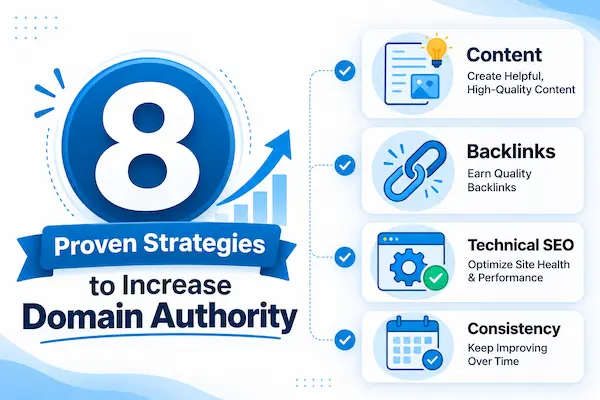
- 8 strategies move the needle — content, ethical outreach, technical health, backlink cleanup, internal links, competitor gaps, content refreshes, and consistency.
- They all point to one theme: earning trust signals gradually, not chasing a single quick win.
- Most sites see movement in 3-6 months of consistently applying these strategies together.
- A fast DA jump isn’t always good news — it’s often a burst of low-quality links that gets discounted later.
- Prioritize 2-3 strategies at once rather than spreading effort thin across all eight simultaneously.
There’s no single trick for how to increase domain authority — it’s eight consistent, compounding habits, not one shortcut.
How to Increase Domain Authority: What Actually Moves the Score
Short answer: Domain Authority rises mainly through earning quality backlinks from relevant sites, keeping your technical SEO healthy, and staying consistent over months — not through any single quick action.
Before diving into tactics, it helps to remember what Domain Authority actually measures — a prediction of your site’s ranking potential based largely on your backlink profile. For the full breakdown, see our domain authority definition guide. Because it’s a backlink-driven, machine-learning score, the strategies that genuinely move it all point back to one theme: earning trust signals consistently, not chasing a single quick win.
1. Publish In-Depth, Genuinely Helpful Content
Content is what earns links in the first place. Thin, generic articles rarely attract backlinks, while comprehensive guides that actually solve a reader’s problem get referenced, cited, and linked to naturally over time. Aim for content that answers a question more completely than what’s currently ranking, rather than simply matching word count for its own sake.
2. Earn Backlinks Through Ethical Guest Posting and Outreach
Manual, relevant outreach remains one of the most reliable ways to build authority. Our guide on how to do blogger outreach walks through the process of finding and pitching sites that are actually relevant to your niche, rather than mass-blasting irrelevant ones. Studying real examples helps too — see our guide to high domain authority websites for what strong link targets actually look like.
3. Fix Technical SEO Issues That Waste Crawl Budget
Broken internal links, slow page speed, and crawl errors don’t just hurt user experience — they can prevent search engines and link equity from flowing properly through your site. Our off-page SEO guide touches on why technical health supports authority growth, not just rankings directly. A quick monthly crawl with any free auditing tool is usually enough to catch the issues that matter most.
4. Audit and Disavow Toxic Backlinks
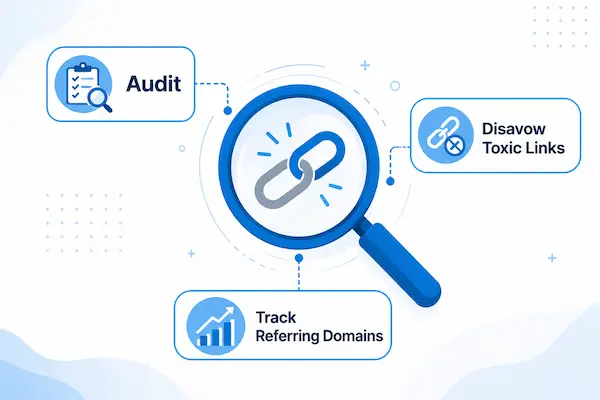
A backlink profile full of spammy, irrelevant, or purchased links can actively hold your Domain Authority back. Regularly reviewing your backlink profile in Google Search Console or a backlink tool and disavowing genuinely harmful links keeps your profile clean.
⚠️ Watch out: Don’t try to run all 8 strategies at once. Spreading effort too thin across every tactic simultaneously usually produces slower, less measurable results than focusing on 2-3 at a time and actually finishing them.
5. Strengthen Internal Linking
Internal links help distribute authority across your own site and help search engines understand which pages matter most. A logical, well-connected site structure — like the pillar-and-cluster model used across this blog — supports this directly.
6. Analyze Competitor Backlink Gaps
Looking at where your competitors get links that you don’t is one of the most efficient ways to find realistic, relevant link opportunities, rather than guessing at outreach targets. It also tells you which sites in your niche are already open to linking out, which shortens the outreach research phase considerably.
7. Refresh and Update Older Content Regularly
Content that stays accurate and current continues earning links and engagement long after publication. Outdated statistics or broken examples quietly reduce a page’s ability to keep attracting new backlinks.
8. Stay Consistent Over the Long Term
Domain Authority compounds. Sites that publish and build links steadily over months and years see far more durable growth than those chasing a short burst of link-building activity, then stopping. For a deeper technical reference on how these signals are weighted, Google’s own SEO Starter Guide is a useful cross-check, even though it doesn’t discuss Domain Authority directly (Google doesn’t use Moz’s metric).
💡 Pro tip: Pick 2-3 strategies from this list that fit your current resources best, commit to them for at least a full quarter, and only then add more — this is exactly what worked in the practical example below.
| Strategy | Typical Effort | Realistic Timeframe |
|---|---|---|
| Helpful content | Ongoing | 3-12 months |
| Ethical outreach | High | 2-6 months |
| Technical SEO fixes | Medium | 1-3 months |
| Backlink audit/disavow | Low-Medium | 1-2 months |
| Internal linking | Low | Ongoing |
| Competitor gap analysis | Medium | 2-4 months |
| Content refreshes | Medium | Ongoing |
| Consistency over time | Ongoing | 6+ months |
How Long Does It Take to Increase Domain Authority?
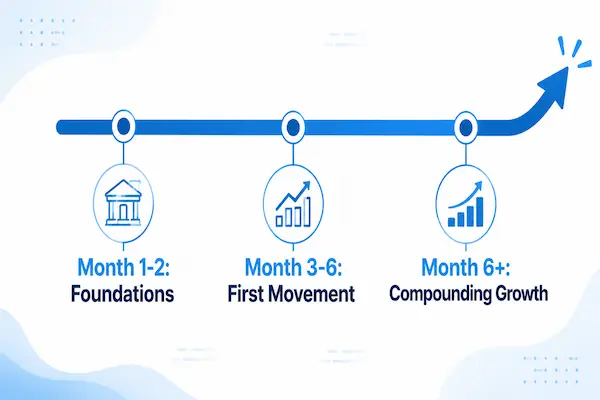
Most sites that consistently apply the strategies above start seeing measurable movement within 3 to 6 months, though this varies heavily based on starting authority, niche competitiveness, and how consistently the work is done. Ahrefs’ explainer on its comparable Domain Rating metric notes these scores move on a logarithmic scale — meaning progress from a low starting score is naturally faster than progress at an already-high score, so early movement can feel encouraging even before the harder climb later on. Our measuring blogger outreach ROI guide covers how to track this kind of progress properly instead of checking your score every few days.
📊 From practical outreach experience:
On one client site, we focused purely on strategies 2, 5, and 6 above for four months — relevant guest posting, tightening internal links, and closing competitor backlink gaps — without touching anything else. The DA moved from the low 20s to the low 30s in that window, which lined up with roughly 15 new relevant referring domains earned during the same period. It wasn’t dramatic, but it was steady, and it held — because the links were genuinely relevant rather than bulk-purchased. The biggest lesson from that project was resisting the urge to add more tactics mid-way through; sticking to just three strategies made it far easier to tell which ones were actually working.
Common Mistakes That Quietly Slow Domain Authority Growth
Even sites doing several things right can stall out because of a few avoidable habits. Watching for these tends to matter as much as adding new tactics, and most of them are easy to fix once you notice the pattern.
Buying Links Instead of Earning Them
Purchased links are often exactly the kind of pattern Moz’s model is built to discount. They can produce a short-term bump followed by a flatline or decline once the link network is identified.
Ignoring Anchor Text Diversity
A backlink profile where every link uses the same exact-match anchor text looks manufactured rather than natural, which can undermine the very trust signals you’re trying to build.
Treating DA as the Goal Instead of a Signal
Domain Authority is a useful proxy for tracking progress, but optimizing for the number itself — rather than for genuine relevance and quality — tends to produce shortcuts that backfire later.
Giving Up Too Early
Because DA moves slowly and unevenly, it’s common to abandon a strategy after 6-8 weeks with no visible change, right before it would have started showing results.
Neglecting Existing Pages While Chasing New Links
Outreach and link building tend to get all the attention, while pages that already rank get left untouched for years. Refreshing an existing page that already has some backlink equity is often faster than starting outreach for a brand-new one from zero.
Learn More
Watch: How Domain Authority Growth Actually Works
This video (also referenced on our pillar guide) covers the fundamentals of how DA is calculated, useful context before applying any of the strategies above.
Conclusion
There’s no single trick for how to increase domain authority — it comes down to consistently applying the eight strategies above and giving them enough time to compound. Focus on relevance and quality over speed, and the score follows as a natural side effect of doing the work right. Pick two or three strategies that fit your current resources, track your progress every quarter rather than every week, and resist both the urge to chase shortcuts and the urge to quit early.
Want a prioritized, done-for-you plan instead of tackling all 8 strategies alone?
Frequently Asked Questions
What is the fastest way to increase Domain Authority?
There’s no instant method, but earning backlinks from relevant, already-trusted sites through genuine outreach tends to produce the most noticeable movement in the shortest realistic timeframe.
How to increase domain authority without building new backlinks?
Some improvement is possible through internal linking and cleaning up toxic backlinks, but meaningful, lasting growth almost always requires earning new quality referring domains.
Does publishing more content directly increase Domain Authority?
Not by itself. Content only helps DA when it earns backlinks or supports a stronger internal linking structure — volume alone doesn’t move the score.
Can Domain Authority go down?
Yes. Losing high-quality backlinks, accumulating spammy links, or a stagnant, inactive site can all cause DA to decline over time.
Is a fast DA increase always a good sign?
Not necessarily. A sudden jump from a burst of low-quality or purchased links is often followed by a decline once those links are discounted — steady, earned growth is more durable.
Should I try all 8 strategies at the same time?
No. Prioritizing 2-3 strategies for a full quarter tends to produce clearer, more measurable results than spreading thin effort across all eight at once.
Related Reading
- Domain Authority Definition: 6 Key Things to Know
- How to Do Blogger Outreach
- Measuring Blogger Outreach ROI
- High Domain Authority Websites: 7 Real Examples
More on this topic soon: our upcoming comparison of Domain Authority vs Authority Score — linked here once it publishes.