
Running the same website through two different SEO tools and getting two completely different authority scores is more common than it should be — and confusing if you don’t know why it happens.
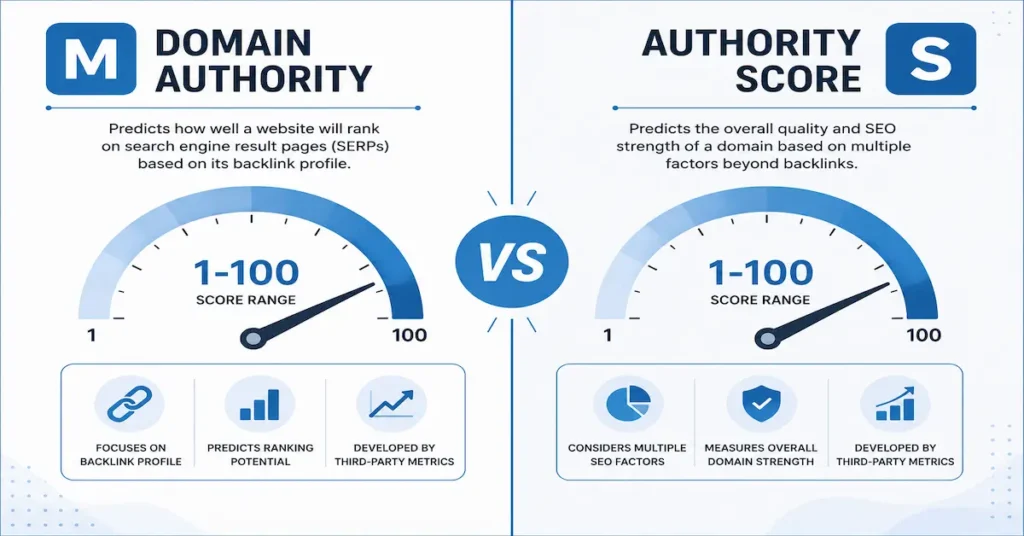
Domain Authority and Authority Score aren’t measuring the same thing the same way, even though both use a familiar 1-100 scale. This guide breaks down domain authority vs authority score in plain terms — what each one actually measures, why the numbers rarely match for the same site, and which one to lean on for different SEO decisions.
⚡ TL;DR
- They’re different metrics from different companies — Domain Authority is Moz’s score, Authority Score is Semrush’s.
- Both use a 1-100 scale, which is exactly why they get confused for the same thing.
- Authority Score factors in estimated traffic and spam signals directly; Domain Authority weighs almost entirely on backlink data.
- A site can score well on one and poorly on the other — that’s expected, not a bug in either tool.
- Use both together for a fuller picture rather than treating either as the single “correct” number.
Domain Authority and Authority Score are both authority metrics on a 1-100 scale — but they’re built from different data by different companies, so treating them as interchangeable is where most of the confusion starts.
- Domain Authority vs Authority Score: What's the Actual Difference
- What Is Domain Authority?
- What Is Authority Score?
- Domain Authority vs Authority Score: Side-by-Side Comparison
- Why the Two Scores Rarely Match for the Same Site
- Which One Should You Use for SEO Decisions?
- Page Authority vs Domain Authority: A Different Mix-Up
- Common Misconceptions About Domain Authority vs Authority Score
- Learn More
- Conclusion
- Frequently Asked Questions
Domain Authority vs Authority Score: What’s the Actual Difference
Short answer: Domain Authority (from Moz) is a backlink-focused prediction of ranking potential, while Authority Score (from Semrush) combines backlink strength, estimated organic traffic, and spam signals into one composite number — different inputs produce different scores even for the same website.
Both scores exist for the same basic reason: search engines don’t publish an official authority number, so SEO tool companies built their own models to estimate it. For the full mechanics of Moz’s version specifically, see our domain authority definition guide. Semrush built Authority Score as its own answer to the same problem, using a different formula and a different underlying dataset — which is exactly why the two numbers can diverge for a site you’re evaluating right now.
What Is Domain Authority?
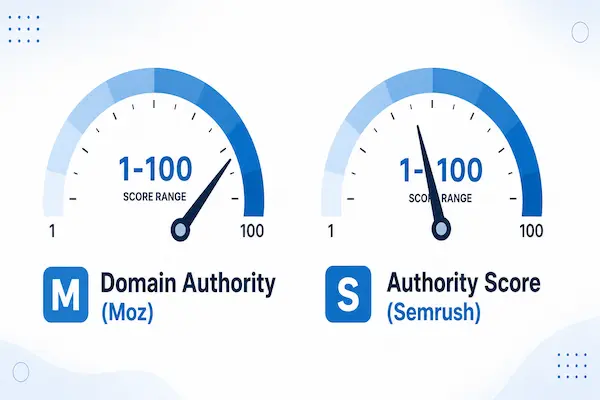
Domain Authority is Moz’s proprietary metric, scored on a 1-100 scale, built almost entirely from backlink data — the number of linking root domains, the quality of those domains, and how your overall backlink profile compares to the rest of the web in Moz’s index. It’s a relative, comparative score rather than an absolute measure of quality, which is a distinction our domain authority definition guide covers in more depth. Because it’s recalculated periodically rather than in real time, small day-to-day link changes won’t move it immediately.
What Is Authority Score?
Authority Score is Semrush’s equivalent metric, also scored 1-100, but built from three combined inputs rather than backlinks alone: link power (referring domain volume and quality), estimated organic search traffic, and a “natural profile” component that flags spam-like link patterns. Semrush’s own knowledge base explainer breaks down these three components in detail. Because traffic and spam signals are baked directly into the formula, a site with a strong backlink profile but weak organic visibility can score noticeably lower on Authority Score than it does on Domain Authority. It also means Authority Score can shift somewhat faster than Domain Authority, since traffic estimates and spam signals can move between updates even without any change in the backlink profile itself.
Domain Authority vs Authority Score: Side-by-Side Comparison
| Metric | Domain Authority (DA) | Authority Score (AS) |
|---|---|---|
| Created by | Moz | Semrush |
| Scale | 1-100 | 1-100 |
| Primary inputs | Backlink profile only | Backlinks + estimated traffic + spam signals |
| Update frequency | Periodically, roughly monthly | Every 2 weeks |
| Best used for | Comparing backlink strength alone | A broader trust/quality snapshot |
⚠️ Watch out: Don’t assume the lower of the two scores is “wrong.” A DA 45 / AS 28 site and a DA 32 / AS 41 site are both giving you accurate information — just about different things. The gap itself is useful data, not an error to resolve.
Why the Two Scores Rarely Match for the Same Site
Because Authority Score pulls in estimated organic traffic and spam-pattern detection directly, two sites with similar backlink profiles can land on very different Authority Scores if one gets more organic search traffic meaningfully or has a cleaner-looking link pattern. Domain Authority, by contrast, stays focused on the backlink side alone, so a site with an aggressive but mostly legitimate link-building history can still score well on DA even with modest traffic. Neither approach is more “correct” — they’re simply weighting different signals. This is also why a site recovering from a traffic drop (say, after losing rankings for a seasonal topic) can see its Authority Score dip noticeably faster than its Domain Authority, even with an unchanged backlink profile.
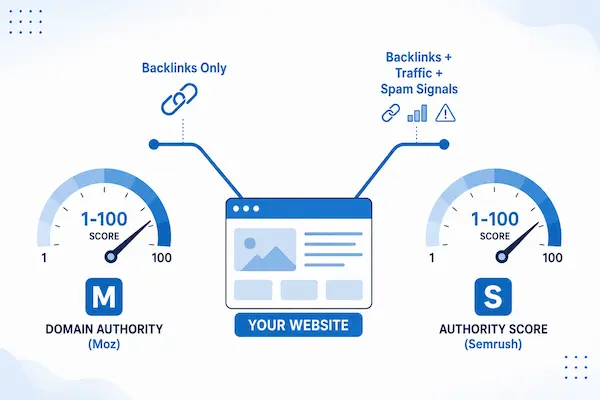
💡 Pro tip: When you’re vetting a link prospect, pull both numbers if you have access to both tools. Agreement between DA and AS is a good sign; a big gap is worth a manual look at the site’s actual traffic and link quality before deciding.
Which One Should You Use for SEO Decisions?
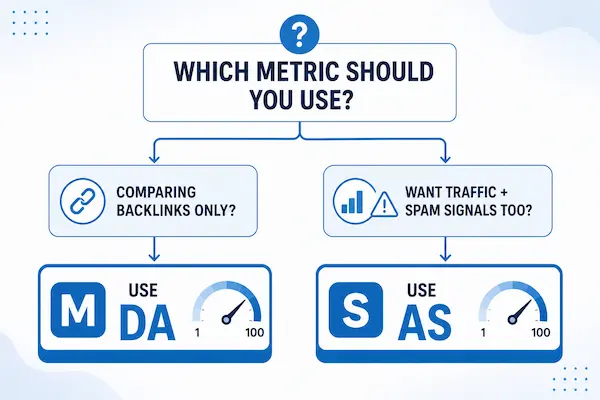
If you’re specifically evaluating backlink strength — say, comparing two guest posting prospects purely on link profile — Domain Authority is the more direct fit. If you want a broader read that also accounts for whether a site is actually getting organic traffic and whether its link profile looks natural, Authority Score adds that extra layer. Most experienced outreach teams end up checking both rather than picking one as their permanent standard. For content marketers reporting results upward, it’s often simplest to pick one metric as the primary reporting number and mention the other only when there’s a meaningful discrepancy worth explaining.
📊 From practical outreach experience:
While evaluating two guest post prospects for a client last year, one site showed a Domain Authority of 45 but an Authority Score of only 28 — a closer look showed thin organic traffic and a few spam-flagged referring domains despite a decent overall link count. A second site showed the reverse: DA 32 but Authority Score 41, backed by steady organic traffic and a clean backlink profile. We placed the content on the second site, and it’s still sending real referral traffic today. Relying on Domain Authority alone would have pointed us toward the weaker prospect.
Page Authority vs Domain Authority: A Different Mix-Up
Short answer: Page Authority (PA) and Domain Authority (DA) are both Moz metrics scored 0–100, but PA measures how likely one specific page is to rank, while DA measures the ranking strength of the entire domain. They get confused because they share the same 0–100 scale and link-based model — just at different scopes.
| Metric | Measures | Scope |
|---|---|---|
| Page Authority (PA) | Predicted ranking strength of one specific URL | Single page |
| Domain Authority (DA) | Predicted ranking strength of the whole site | Entire domain |
This distinction matters most when you’re vetting a guest-post or backlink opportunity: a homepage’s high DA doesn’t guarantee the specific article page you’ll be linked from carries the same weight. A brand-new, unlinked blog post can have a low PA even on a high-DA site — always check the PA of the exact page, not just the domain’s overall score.
Common Misconceptions About Domain Authority vs Authority Score
A lot of the confusion between these two metrics comes down to a handful of assumptions that sound reasonable but don’t hold up once you look at how each score is actually built — worth clearing up before you use either number to make a real decision.
“They’re Just Two Names for the Same Thing”
They’re not. Domain Authority and Authority Score come from two separate companies, built on separate datasets and separate formulas. The shared 1-100 scale is a coincidence of design choice, not evidence that they measure the same underlying signal.
“A Higher Number Always Means More Organic Traffic”
Not necessarily for Domain Authority, since it’s backlink-focused and doesn’t factor traffic in directly. Authority Score is closer to true here since traffic is one of its inputs, but even then, a high score doesn’t guarantee traffic for every specific page on the site — only a traffic signal at the domain level.
“Google Uses One of These Scores to Rank Sites”
Google doesn’t use either metric. Both are third-party estimates built to approximate ranking potential, not inputs Google’s own algorithm reads.
“The Free Version of Either Tool Shows the Full Picture”
Free tiers of both platforms typically show the current score but limit access to the underlying backlink and traffic data that explains why the score is what it is — the full context usually requires a paid account.
“Both Scores Update on the Same Schedule”
They don’t. Semrush refreshes Authority Score roughly every two weeks, while Moz’s update cadence for Domain Authority has historically been closer to monthly — so checking both on the same day can occasionally show numbers based on slightly different index snapshots.
Learn More
Watch: How Domain Authority Growth Actually Works
This video (also referenced on our pillar guide and other cluster posts) covers the DA/PA fundamentals that underpin this comparison — it doesn’t cover Authority Score directly, since that’s a Semrush-specific metric.
Conclusion
Domain authority vs authority score isn’t really a question of which one is right — they’re two different, legitimate ways of estimating the same rough idea, built from different data by two separate companies. Use Domain Authority when you specifically want a backlink-focused comparison, lean on Authority Score when you want traffic and spam signals factored in too, and treat a meaningful gap between the two as a prompt to look closer, not as an error in either tool. If you only have access to one of the two tools, that’s still perfectly workable — just be consistent about which metric you’re comparing across prospects, rather than mixing DA numbers for some sites and AS numbers for others.
Want prospects vetted properly against both metrics before you ever see them?
Frequently Asked Questions
Is Authority Score the same as Domain Authority?
No. They’re separate metrics from separate companies (Semrush and Moz) that happen to share a similar 1-100 scale, but are calculated from different data.
Domain authority vs authority score — which one do clients usually ask about?
It depends on which tool they’re already using, but Domain Authority tends to come up more often simply because Moz’s metric has been around longer and is more widely recognized by name.
Why is my site’s Authority Score lower than its Domain Authority?
This usually means your backlink profile looks stronger than your actual organic traffic or natural-profile signals — Authority Score factors those in directly, while Domain Authority doesn’t.
Can a site have a high Authority Score but a low Domain Authority?
Yes. Strong organic traffic and a clean link pattern can lift Authority Score even if the raw backlink volume Moz measures for Domain Authority is more modest.
Should I stop using Domain Authority and switch to Authority Score?
Not necessarily. They measure overlapping but different things — many SEOs check both rather than replacing one with the other.
Does Google use either Domain Authority or Authority Score?
No. Both are third-party metrics built by Moz and Semrush, respectively — Google doesn’t use either one directly in its ranking systems.
Which score should I quote when reporting to a client?
Whichever tool your client already recognizes, it’s worth briefly explaining that the number reflects one specific tool’s model, not an official, universal industry score — so expectations stay realistic if they check a different tool later.
Is Page Authority the same as Domain Authority?
No — Page Authority scores a single URL’s ranking strength, while Domain Authority scores the whole domain. Both are Moz metrics on a 0–100 scale, but they answer different questions.