
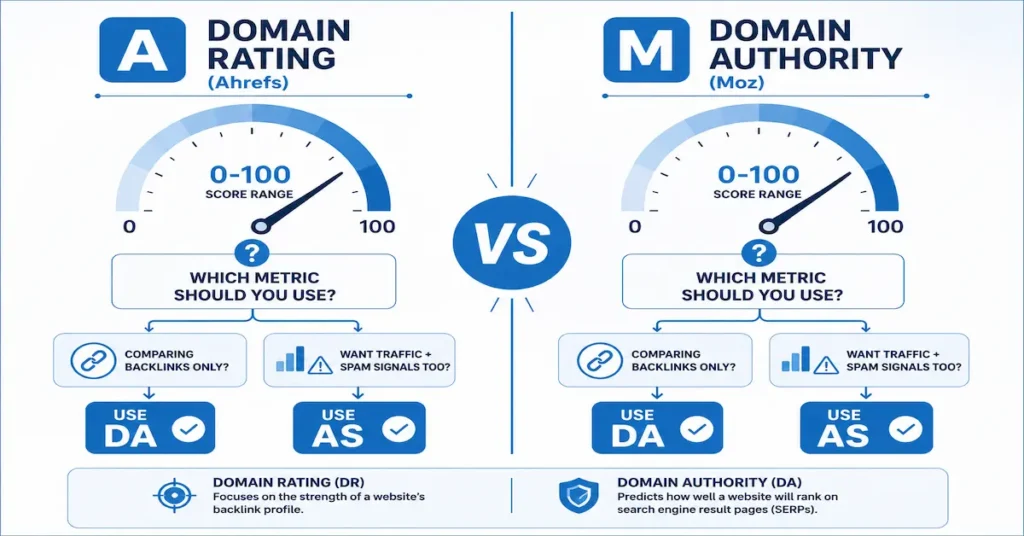
Pull up the same website in Ahrefs and Moz, and you’ll often see two noticeably different scores — one calling it a Domain Rating of 55, the other a Domain Authority of 38. Neither tool is wrong; they’re simply not measuring the same thing.
Domain Rating and Domain Authority both use a familiar 0-100 scale, which is exactly why they get treated as interchangeable when they aren’t. This guide breaks down domain rating vs domain authority in plain terms — what each one actually measures, why the numbers rarely line up for the same site, and which one makes more sense for different SEO decisions.
⚡ TL;DR
- Domain Rating is Ahrefs’ metric; Domain Authority is Moz’s — two separate companies, two separate formulas.
- Domain Rating is purely backlink-focused — it deliberately excludes traffic, content, and spam signals.
- Domain Authority factors in more variables, making it a broader (but slower-moving) estimate of ranking potential.
- A DR 50 site and a DA 50 site aren’t equivalent — the scales aren’t built to be cross-compared number-for-number.
- Use each for what it’s good at — DR for quick backlink-strength checks, DA for a wider trust signal.
Domain Rating and Domain Authority share a 0-100 scale and a similar goal, but they’re built by two different companies from two different formulas — treating the numbers as directly comparable is where most of the confusion starts.
- Domain Rating vs Domain Authority: What's the Actual Difference
- What Is Domain Rating?
- What Is Domain Authority?
- Domain Rating vs Domain Authority: Side-by-Side Comparison
- Why Domain Rating and Domain Authority Numbers Rarely Match
- Which One Should You Use?
- Common Misconceptions About Domain Rating vs Domain Authority
- How to Check Both Scores for Your Own Site
- Learn More
- Conclusion
- Frequently Asked Questions
Domain Rating vs Domain Authority: What’s the Actual Difference
Short answer: Domain Rating (from Ahrefs) is a pure backlink-strength score based on referring domains and their own authority, while Domain Authority (from Moz) folds in a broader mix of backlink and trust signals — different formulas, built by different companies, so the same site can show two different numbers.
Both metrics try to answer the same underlying question — how strong is this site’s backlink profile — but they weight the inputs differently. For the full mechanics of Moz’s version, see our domain authority definition guide. Ahrefs built Domain Rating as a deliberately narrower, faster-updating alternative, which is exactly why the two scores can diverge for a site you’re checking right now.
What Is Domain Rating?
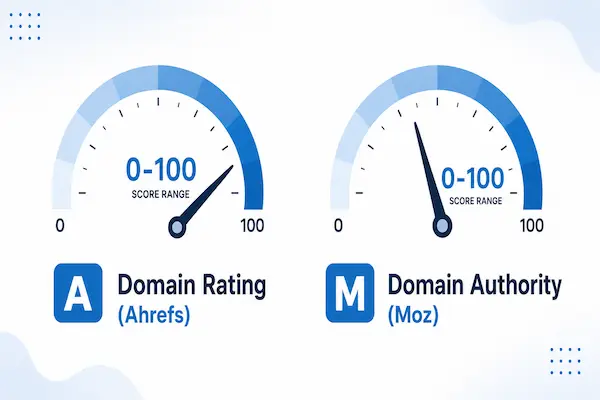
Domain Rating is Ahrefs’ proprietary metric, scored 0-100 on a logarithmic scale, built entirely from backlink data — specifically the number of unique referring domains pointing to a site and the authority of those referring domains themselves. Ahrefs’ own Domain Rating explainer is worth reading directly if you want the full calculation logic. Unlike Domain Authority, DR deliberately leaves out organic traffic, content quality, domain age, and spam signals — it’s a narrower, more focused number by design. This narrow focus is also why DR is often the first number outreach teams check when screening a large batch of prospects quickly — it reacts faster and requires less interpretation than a broader metric would.
What Is Domain Authority?
Domain Authority is Moz’s equivalent metric, also scored 0-100, but built from a wider mix of signals — linking root domains, link quality, and how a site’s overall backlink profile compares across Moz’s index. It’s a relative, comparative score rather than an absolute one, a distinction covered in more depth in our domain authority definition guide. Because it factors in more variables than DR, it tends to update less frequently and can feel slower to reflect very recent link changes. This is a deliberate design choice on Moz’s part, not a flaw — a broader signal set naturally takes longer to stabilize than a narrower one focused on backlinks alone.
Domain Rating vs Domain Authority: Side-by-Side Comparison
| Metric | Domain Rating (DR) | Domain Authority (DA) |
|---|---|---|
| Created by | Ahrefs | Moz |
| Scale | 0-100 (logarithmic) | 1-100 |
| Primary inputs | Referring domains + their authority | Broader backlink profile mix |
| Calculation basis | Backlinks only, nothing else | Backlinks plus additional signals |
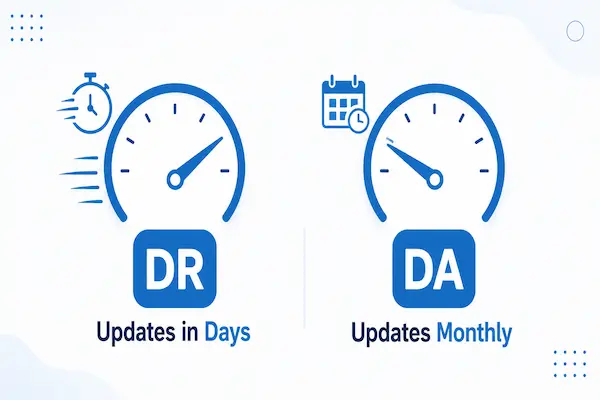
| Update frequency | Frequently, often within days | Periodically, roughly monthly |
| Best used for | A fast, pure backlink-strength check | A broader ranking-potential estimate |
⚠️ Watch out: Don’t assume a DR 50 site is directly comparable to a DA 50 site elsewhere. The two scales aren’t built to line up number-for-number — a meaningful comparison only works when you’re comparing DR to DR, or DA to DA, across similar sites.
Why Domain Rating and Domain Authority Numbers Rarely Match
Because Domain Rating is narrowly focused on referring domains and their authority, it can move quickly when a site earns (or loses) a batch of strong backlinks. Domain Authority, factoring in a wider set of signals and updating less often, tends to respond more gradually to the same changes. A site with a sudden burst of new, strong referring domains might see its DR jump within days while its DA takes weeks to catch up — not because Moz is “behind,” but because it’s weighing a broader, slower-moving picture. Neither behavior is a defect — it’s simply the tradeoff between a fast, narrow signal and a slower, broader one.
💡 Pro tip: When benchmarking against competitors, compare each metric within itself — your DR against their DR, your DA against their DA — rather than cross-comparing a competitor’s DR to your own DA.
Which One Should You Use?
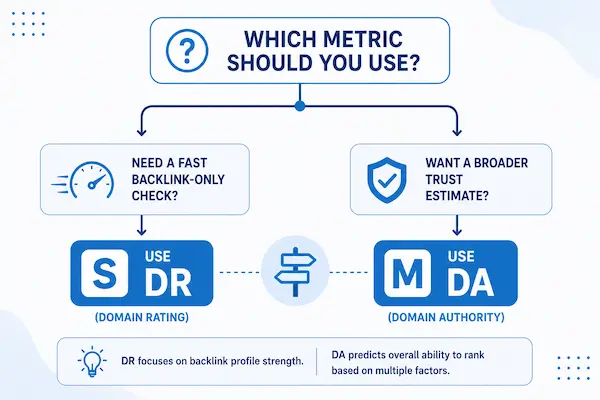
If you want a fast, focused read on backlink strength alone — useful for quick outreach-prospect screening — Domain Rating is the more direct tool. If you want a broader estimate that factors in more of the picture, even if it updates more slowly, Domain Authority fits better. Many SEOs end up checking both, the same way it’s worth checking Domain Authority against Authority Score rather than relying on a single number.
📊 From practical outreach experience:
While benchmarking a client’s site against three direct competitors last quarter, one competitor showed the lowest Domain Rating of the group at 28, which on its own made it look like the weakest link-building threat. But its Domain Authority came in at 41 — the highest of the three — reflecting stronger overall trust signals despite a thinner raw referring-domain count. We ended up prioritizing that competitor first in the gap analysis, a call the DR number alone would have missed entirely.
Common Misconceptions About Domain Rating vs Domain Authority
A few assumptions come up constantly when these two metrics get compared, and most of them fall apart once you look at how each is actually calculated.
“A DR 50 Site Equals a DA 50 Site”
It doesn’t. The two scales are built from different formulas and different datasets — matching numbers is coincidence, not equivalence.
“Domain Rating Is Just Ahrefs’ Version of Domain Authority”
Not quite. DR deliberately excludes traffic, content quality, and spam signals that factor into DA — it’s a narrower metric by design, not a rebrand of the same idea.
“A Higher DR Always Means More Total Backlinks”
Not necessarily. DR weighs the authority of referring domains, not just their raw count — a handful of links from very strong domains can outweigh a large number from weak ones.
“You Should Pick One Metric and Ignore the Other”
Not recommended. Since they weight different signals, checking both gives a fuller picture than relying on either alone — the same logic that applies to Domain Authority vs Authority Score.
“Google Uses One of These Metrics to Rank Sites”
No. Both are third-party estimates built by Ahrefs and Moz respectively — Google’s own ranking systems don’t read either one directly.
How to Check Both Scores for Your Own Site
Checking both metrics side by side takes only a few minutes and doesn’t require a paid subscription to either tool.
Checking Domain Rating
Ahrefs’ free Website Authority Checker shows a site’s current DR without needing a full account, and the Ahrefs Webmaster Tools free tier gives a more detailed backlink breakdown for your own verified site.
Checking Domain Authority
Moz’s free MozBar browser extension shows DA directly in the search results as you browse, and Moz’s Link Explorer tool gives the same number along with linking-domain data for any site you look up, not just your own.
Running both checks on the same handful of prospects before an outreach campaign takes a few extra minutes but consistently produces a more reliable picture than checking either score alone — the same principle covered in our Domain Authority vs Authority Score comparison.
Learn More
Watch: Ahrefs Domain Rating Explained
This video walks through Ahrefs’ Domain Rating specifically — a different video from the DA/PA explainer used on our other Domain Authority posts, since this one focuses on the metric this comparison is actually about.
Conclusion
Domain rating vs domain authority isn’t a question of which tool got it “right” — they’re two legitimate, differently-weighted ways of estimating backlink strength, built by two separate companies. Use Domain Rating when you want a fast, focused backlink-only read, lean on Domain Authority for a broader estimate, and always compare each metric within itself rather than cross-referencing the two scales directly. Whichever tool you check first, the underlying goal is the same: understanding a site’s real backlink strength well enough to make a confident outreach or competitor decision.
Want your backlink strategy benchmarked properly across every metric that matters?
Frequently Asked Questions
Is Domain Rating the same as Domain Authority?
No. They’re separate metrics from separate companies (Ahrefs and Moz) that share a similar 0-100 scale but are calculated from different formulas.
Domain rating vs domain authority — which updates faster?
Domain Rating typically updates faster, often within days of new backlinks appearing, while Domain Authority updates more periodically, roughly monthly.
Why is my site’s Domain Rating higher than its Domain Authority?
This usually means your referring domains are individually strong, even if the broader trust signals Domain Authority also factors in are more modest.
Can a site have a high Domain Authority but a low Domain Rating?
Yes. A wider mix of trust signals can lift Domain Authority even when the specific referring-domain strength Ahrefs measures for DR is less pronounced.
Should I use Domain Rating instead of Domain Authority?
Not necessarily — they measure overlapping but different things. Many SEOs check both rather than treating one as a replacement for the other.
Does Google use Domain Rating or Domain Authority to rank websites?
No. Both are third-party metrics — Google doesn’t use either one directly in its ranking systems.
Is it worth paying for both Ahrefs and Moz just to check both scores?
Not necessarily. Both companies offer free, limited tools that show the current score without a full subscription — a paid plan only becomes worthwhile once you need the deeper backlink data behind the number.
Related Reading
- Domain Authority Definition: 6 Key Things to Know
- High Domain Authority Websites: 7 Real Examples
- How to Increase Domain Authority: 8 Proven Strategies
- Domain Authority vs Authority Score: 5 Real Differences
More on this topic soon: our upcoming guide on whether Google uses Domain Authority directly.